
VIP Peptide Reconstitution Calculator
Enter the amount you want to measure. The vial buttons will highlight which vial strengths create cleaner syringe-unit measurements.
What amount do you need?
Type the target amount, then choose mg or mcg. Example: 2mg or 500mcg.
Syringe size:
Possible vial strengths:
Best Match
Good Match
Usable
Harder to Measure
Example VIP Peptide Titration Schedule
| Protocol Item | Guidance (Source Summary) |
|---|---|
| Dose | 100–500 mcg per dose |
| Cycling / Use Pattern | Commonly used on an as-needed basis |
| Frequency Notes | Dosing frequency and intensity depend on individual response and condition |
| Timing Notes | Described as fast-acting with a short half-life (~2 minutes) |
| Goal / Principle | The goal is not to become dependent on the compound |
Possible vial strengths:
What Is It?
VIP Peptide
Vasoactive intestinal peptide.
Bacteriostatic Water
Sterile water containing a bacteriostatic preservative, commonly used when preparing multi-use research vials.
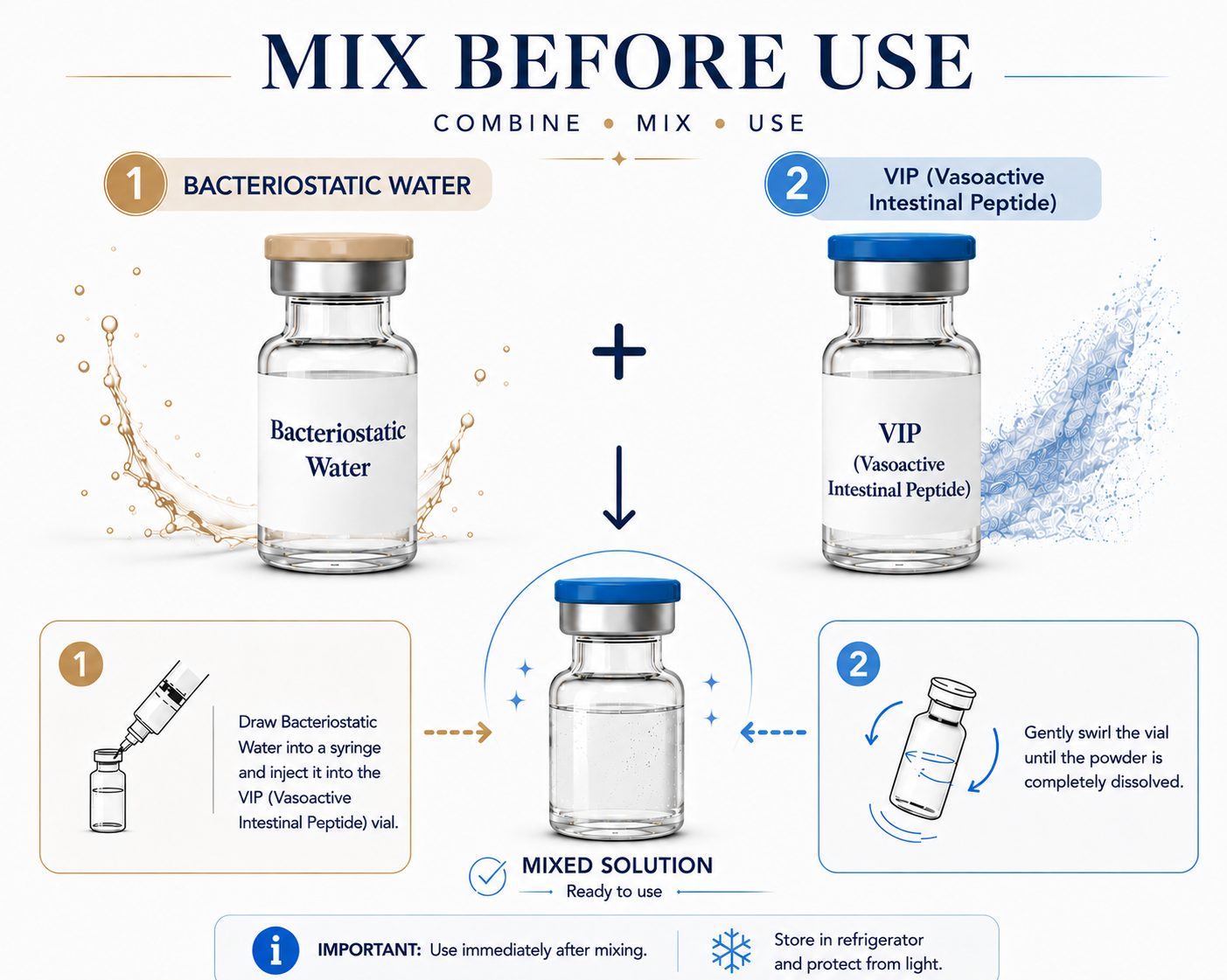
How To Mix VIP Peptide
1
CleanUse alcohol swabs to clean the tops of both vials.
2
Draw BAC WaterDraw the selected amount of bacteriostatic water.
3
Inject SlowlyAdd the liquid slowly down the side of the vial.
4
Swirl GentlyDo not shake. Swirl gently until dissolved.
5
Store ProperlyStore as directed and protect from heat and light.
Best Practices & Common Mistakes
Best Practices
- Use sterile technique.
- Protect from light and heat.
- Store refrigerated when appropriate.
- Use clean syringe-unit math before measuring.
Common Mistakes
- Confusing milligrams with milliliters.
- Choosing an option with awkward decimal units.
- Using too little liquid for very small measurements.
- Shaking the vial aggressively.
VIP Peptide Storage & Handling
Lyophilized Powder: −20°C (−4°F) for long-term storage (up to 24 months). Refrigeration 2–8°C (36–46°F) for short-term use (up to ~3 months). Original sealed vial in the freezer is safest.
Reconstituted Solution: 2–8°C (36–46°F), use within ~7–14 days. Keep sealed, avoid light, and do not repeat freeze-thaw cycles.
Frequently Asked Questions
VIP is a 28-amino-acid neuropeptide from the secretin/glucagon family, first isolated from the intestine in 1970 but found throughout the nerves, brain, lungs, and immune system. Despite the "intestinal" name, it acts body-wide as a vasodilator, a potent anti-inflammatory and immune modulator, and a circadian regulator, signaling through the VPAC1 and VPAC2 receptors. It's most commonly used as a compounded nasal spray, and also sold as a research peptide.
VIP's broadest interest is anti-inflammatory: it's studied in autoimmune and airway conditions, and its strongest conventional clinical evidence is a 2010 trial of inhaled VIP in sarcoidosis. It's also examined for pulmonary arterial hypertension, mast cell activation (MCAS), circadian and neuroprotective effects, and glucose regulation via VPAC2. Most of this is early or small-scale, so outside its diagnostic and investigational settings, these are potential uses rather than proven treatments.
VIP is best known in the alternative-medicine world as the final step of the Shoemaker protocol for CIRS (chronic inflammatory response syndrome) from water-damaged buildings, where it's used to correct inflammatory markers (like TGF-β1 and MMP-9) after upstream issues are addressed. This use is popular but sits outside mainstream medicine and rests on small studies from one research group. It differs from KPV, another anti-inflammatory peptide — VIP is a broad receptor-signaling neuropeptide, while KPV is a tiny tripeptide fragment.
VIP is most often used as a pre-made compounded nasal spray (commonly ~50 mcg per spray), which isn't reconstituted at home; only a research-grade lyophilized powder is mixed. For a 5 mg vial, adding 2 mL of bacteriostatic water gives 2.5 mg/mL, so a 100 mcg amount draws to 0.04 mL (4 units on a U-100 syringe) — very small, which is why nasal delivery is common. With a ~1–2 minute half-life there's no established injectable dose, so any figure is a research choice.
VIP is not FDA-approved for any indication — nasal and injectable forms are compounded or investigational (the injectable analog Aviptadil got Fast Track for COVID-ARDS but isn't approved) — so it's used off-label under a provider. Because it's a potent vasodilator, common effects include facial flushing, a transient drop in blood pressure, and nasal irritation, and it can add to blood-pressure-lowering drugs; loose stools can occur since VIP stimulates intestinal secretion. Storage: keep the powder or spray cold and protected from light, and use reconstituted or compounded solution within its dated window.
Practical takeaway: If your real goal is weight or metabolic health, the most useful next step is discussing approved treatment options with a clinician rather than relying on an unapproved compound.
Important: This tool is for informational and research-reference purposes only. Not intended for human or veterinary use.