
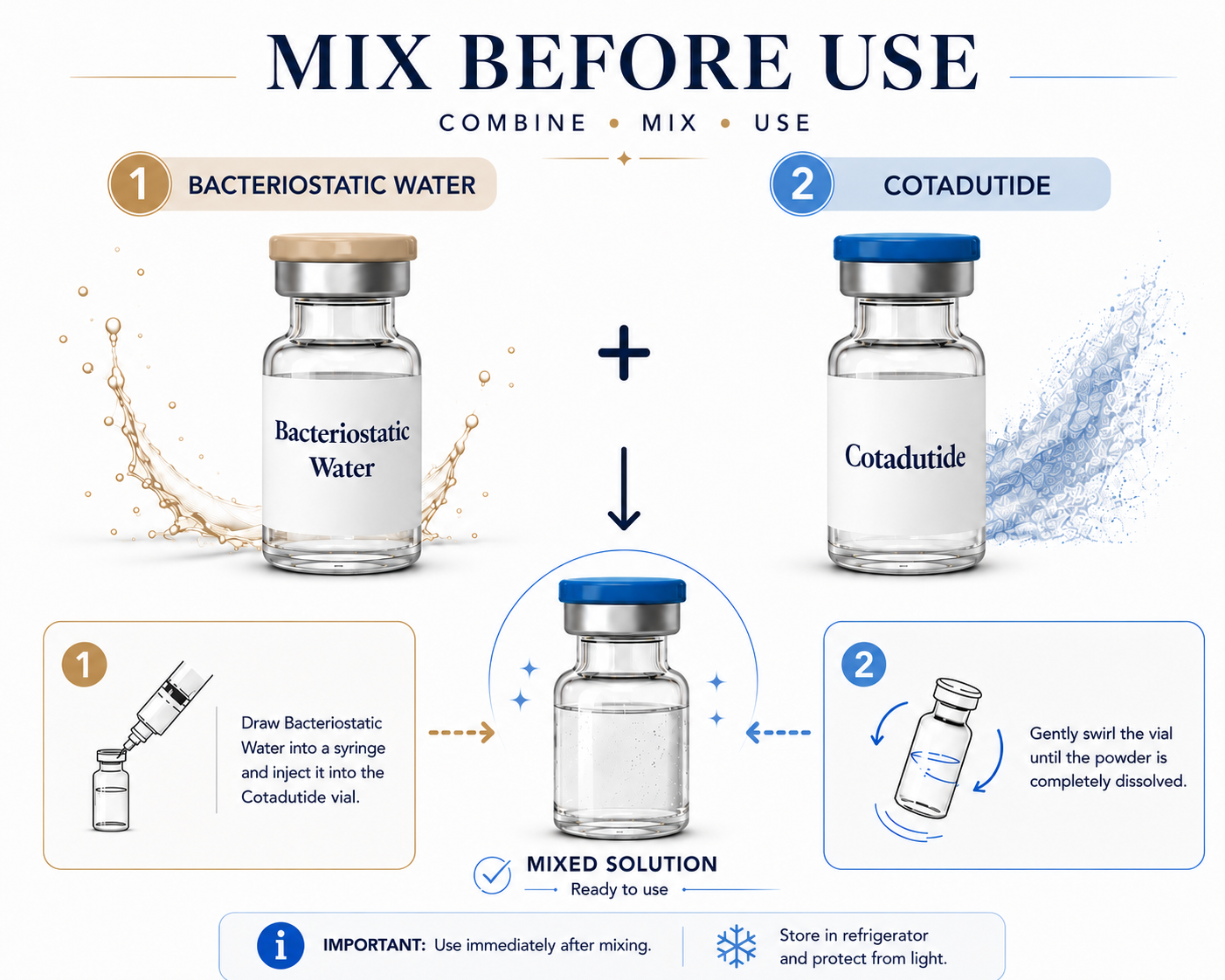
Cotadutide and BAC Water Mix

Cotadutide Reconstitution Calculator

Enter the amount you want to measure. The vial buttons will highlight which vial strengths create cleaner syringe-unit measurements.

What amount do you need?

Type the target amount, then choose mg or mcg. Example: 2mg or 500mcg.

Syringe size:
Possible vial strengths:
Best Match Good Match Usable Harder to Measure

Example Cotadutide Titration Schedule

ParameterDetails
Dosage50–600 µg once daily (titrate: 100 µg → 200 µg → 300 µg → 400 µg → 600 µg)
RouteSubcutaneous (SC)
FrequencyOnce daily
Cycle LengthUp to 26 weeks (clinical trials)
Half‑life~10 hours
ReconstitutionDMSO → dilute in saline or PBS
Possible vial strengths:

What Is It?

Cotadutide

GLP-1 / glucagon dual agonist.

Bacteriostatic Water

Sterile water containing a bacteriostatic preservative, commonly used when preparing multi-use research vials.

How To Mix Cotadutide

1
Clean

Use alcohol swabs to clean the tops of both vials.

2
Draw BAC Water

Draw the selected amount of bacteriostatic water.

3
Inject Slowly

Add the liquid slowly down the side of the vial.

4
Swirl Gently

Do not shake. Swirl gently until dissolved.

5
Store Properly

Store as directed and protect from heat and light.

Best Practices & Common Mistakes

Best Practices

  • Use sterile technique.
  • Protect from light and heat.
  • Store refrigerated when appropriate.
  • Use clean syringe-unit math before measuring.

Common Mistakes

  • Confusing milligrams with milliliters.
  • Choosing an option with awkward decimal units.
  • Using too little liquid for very small measurements.
  • Shaking the vial aggressively.

Cotadutide Storage & Handling

Lyophilized Powder: −20°C (−4°F) for long-term storage (up to 24 months). Refrigeration 2–8°C (36–46°F) for short-term use (up to ~3 months). Original sealed vial in the freezer is safest.
Reconstituted Solution: 2–8°C (36–46°F), use within ~7–14 days. Keep sealed, avoid light, and do not repeat freeze-thaw cycles.

Frequently Asked Questions

Cotadutide was designed as a dual GLP-1 and glucagon receptor agonist, not a GLP-1/GIP drug like tirzepatide. The GLP-1 side was aimed at glucose and appetite pathways, while the glucagon side was studied for effects on energy metabolism and liver-related markers.
MEDI0382 was the development code for cotadutide, so both names point to the same investigational peptide. A calculator page should include both terms because older clinical papers and trial records often use MEDI0382, while searchers may use cotadutide.
Cotadutide did not become an approved medicine and did not move into a full Phase 3 program. AstraZeneca discontinued development for strategic pipeline reasons, not because a new unexpected safety issue was identified.
Cotadutide attracted interest in NASH and metabolic liver research because the glucagon receptor component was linked to hepatic fat and liver biomarker effects. In a 54-week Phase 2b study, researchers tracked not only body weight and HbA1c, but also liver enzymes and fibrosis-related scoring tools.
For research math only, concentration equals peptide amount divided by final liquid volume. For example, if 3 mg of cotadutide research material were brought to a final volume of 6 mL, the concentration would be 0.5 mg/mL; a 150 mcg research amount would equal 0.30 mL, or 30 units on a U-100 scale. This is calculator math only, not a dosing guide.
Practical takeaway: If your real goal is weight or metabolic health, the most useful next step is discussing approved treatment options with a clinician rather than relying on an unapproved compound.
Important: This tool is for informational and research-reference purposes only. Not intended for human or veterinary use.
← All peptides