
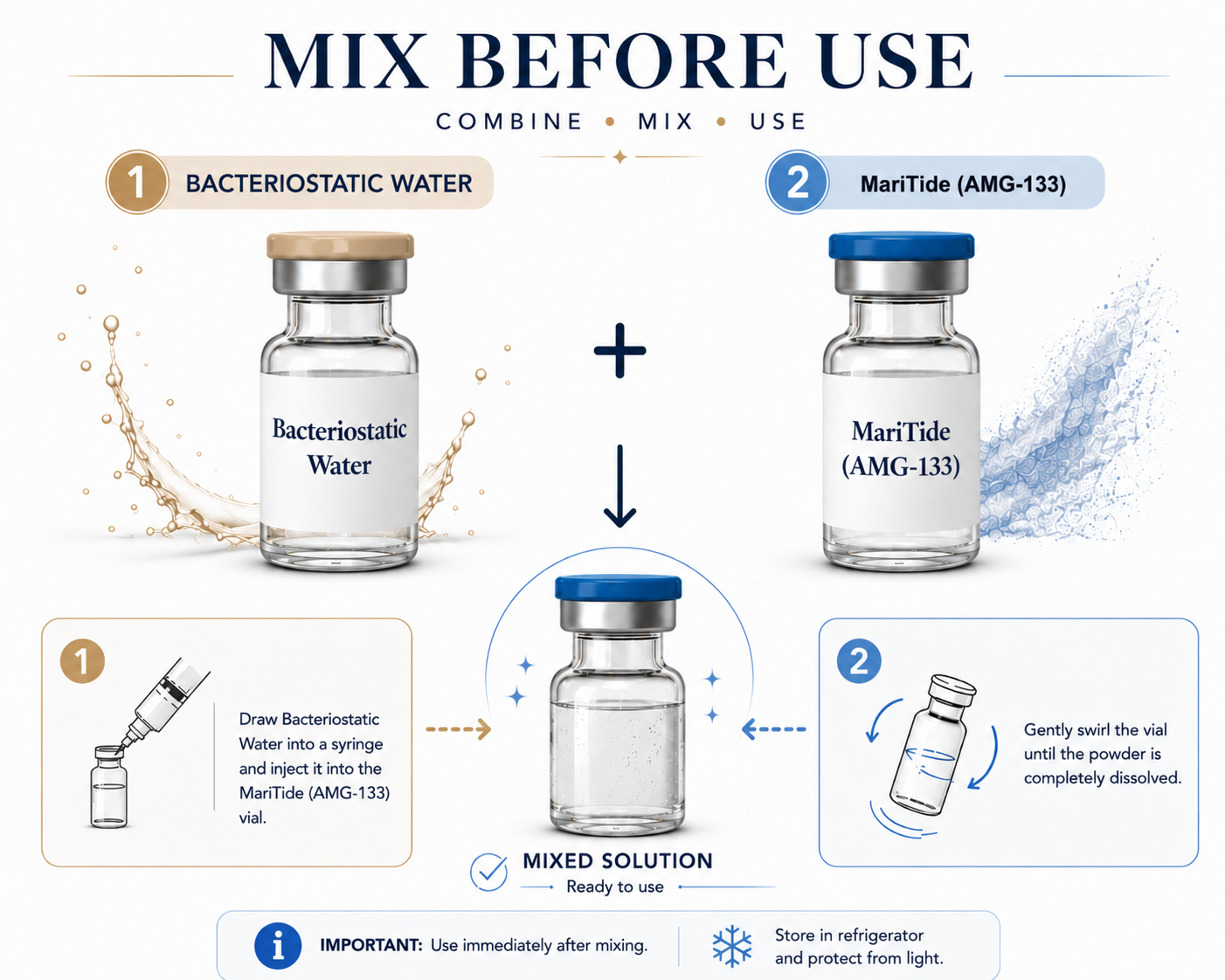
MariTide (AMG-133) and BAC Water Mix

MariTide (AMG-133) Reconstitution Calculator

Enter the amount you want to measure. The vial buttons will highlight which vial strengths create cleaner syringe-unit measurements.

What amount do you need?

Type the target amount, then choose mg or mcg. Example: 2mg or 500mcg.

Syringe size:
Possible vial strengths:
Best Match Good Match Usable Harder to Measure

Example MariTide (AMG-133) Titration Schedule

ParameterDetails
Typical Dosage (Phase 2)Monthly dosing: 140 mg, 280 mg, 420 mg; Every 8 weeks: 420 mg
Starting & Escalation (Phase 3)21 mg → 35 mg → up to 350 mg (8-week titration)
Route of AdministrationSubcutaneous (SC) injection
FrequencyMonthly (every 4 weeks) or less frequent (e.g., every 8–12 weeks)
Cycle LengthClinical trials up to 104 weeks (~2 years) of treatment
Half‑LifeExtended half-life (~13–17 days); supports extended dosing intervals
ReconstitutionSupplied as solution; typically no reconstitution required
Possible vial strengths:

What Is It?

MariTide (AMG-133)

GLP-1 agonist / GIPR antagonist conjugate.

Bacteriostatic Water

Sterile water containing a bacteriostatic preservative, commonly used when preparing multi-use research vials.

How To Mix MariTide (AMG-133)

1
Clean

Use alcohol swabs to clean the tops of both vials.

2
Draw BAC Water

Draw the selected amount of bacteriostatic water.

3
Inject Slowly

Add the liquid slowly down the side of the vial.

4
Swirl Gently

Do not shake. Swirl gently until dissolved.

5
Store Properly

Store as directed and protect from heat and light.

Best Practices & Common Mistakes

Best Practices

  • Use sterile technique.
  • Protect from light and heat.
  • Store refrigerated when appropriate.
  • Use clean syringe-unit math before measuring.

Common Mistakes

  • Confusing milligrams with milliliters.
  • Choosing an option with awkward decimal units.
  • Using too little liquid for very small measurements.
  • Shaking the vial aggressively.

MariTide (AMG-133) Storage & Handling

Lyophilized Powder: −20°C (−4°F) for long-term storage (up to 24 months). Refrigeration 2–8°C (36–46°F) for short-term use (up to ~3 months). Original sealed vial in the freezer is safest.
Reconstituted Solution: 2–8°C (36–46°F), use within ~7–14 days. Keep sealed, avoid light, and do not repeat freeze-thaw cycles.

Frequently Asked Questions

MariTide, also called maridebart cafraglutide or AMG 133, is an investigational obesity drug from Amgen. It is a long-acting antibody-peptide conjugate designed for monthly or less frequent dosing, but it is not FDA-approved or commercially available.
MariTide activates the GLP-1 receptor while blocking the GIP receptor. That is different from tirzepatide, which activates both GLP-1 and GIP receptors, making MariTide a distinct incretin-based approach rather than a copy of existing GLP-1/GIP drugs.
A calculator can only show concentration math, not a clinical dosing plan. For example, if a hypothetical 420 mg research vial is brought to 7 mL final volume, the concentration is 60 mg/mL; 140 mg equals 2.33 mL, 280 mg equals 4.67 mL, and 420 mg equals 7.00 mL.
Yes. Amgen has multiple Phase 3 MARITIME studies evaluating MariTide for chronic weight management and obesity-related conditions. Phase 3 status does not mean approval; MariTide is still investigational until regulators review and approve it.
Tirzepatide is a GLP-1/GIP dual agonist given weekly, while MariTide combines GLP-1 activation with GIP receptor blocking and is being studied for monthly or less frequent dosing. The tradeoff is that tirzepatide is already approved, while MariTide still needs Phase 3 outcomes and regulatory review.
Practical takeaway: If your real goal is weight or metabolic health, the most useful next step is discussing approved treatment options with a clinician rather than relying on an unapproved compound.
Important: This tool is for informational and research-reference purposes only. Not intended for human or veterinary use.
← All peptides