
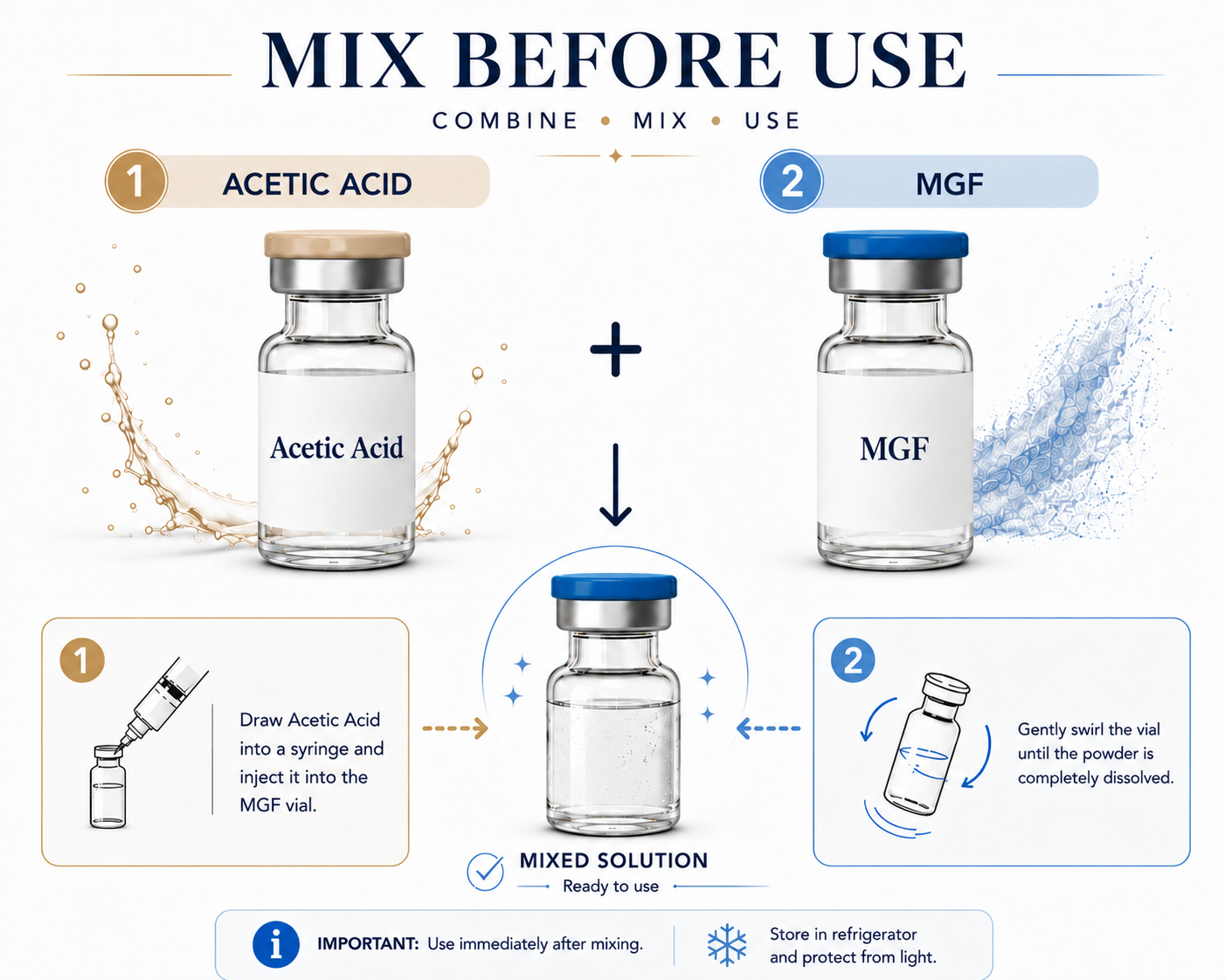
MGF (C-terminal) and Acetic Acid Mix

MGF (C-terminal) Reconstitution Calculator

Enter the amount you want to measure. The vial buttons will highlight which vial strengths create cleaner syringe-unit measurements.

⚠ Use acetic acid — not bacteriostatic water MGF (C-terminal) is insoluble or unstable in standard BAC water. Manufacturer protocols require reconstitution in dilute acetic acid (0.1%) — or, for IGF-1 variants, 50 mM acetic acid. Volumes shown below refer to acetic acid, not water.

What amount do you need?

Type the target amount, then choose mg or mcg. Example: 2mg or 500mcg.

Syringe size:
Possible vial strengths:
Best Match Good Match Usable Harder to Measure

Example MGF (C-terminal) Titration Schedule

WeekDaily Dose (mcg)Injection Volume (mL / Units)
Week 1100 mcg (0.10 mg)0.06 mL (6 units)
Week 2150 mcg (0.15 mg)0.09 mL (9 units)
Week 3200 mcg (0.20 mg)0.12 mL (12 units)
Week 4250 mcg (0.25 mg)0.15 mL (15 units)
Weeks 5–8300 mcg (0.30 mg)0.18 mL (18 units)
Possible vial strengths:

What Is It?

MGF (C-terminal)

Mechano growth factor C-terminal peptide.

Acetic Acid (0.1%)

A dilute solution of acetic acid (typically 0.1% for most peptides, or 50 mM for IGF-1 variants) used to reconstitute peptides that are insoluble or unstable in standard bacteriostatic water. MGF (C-terminal) requires an acidic carrier to dissolve fully and remain stable — plain BAC water will not work and may damage the peptide.

How To Mix MGF (C-terminal)

1
Clean

Use alcohol swabs to clean the tops of both vials.

2
Draw Acetic Acid

Draw the selected amount of 0.1% acetic acid.

3
Inject Slowly

Add the liquid slowly down the side of the vial.

4
Swirl Gently

Do not shake. Swirl gently until dissolved.

5
Store Properly

Store as directed and protect from heat and light.

Best Practices & Common Mistakes

Best Practices

  • Use sterile technique.
  • Protect from light and heat.
  • Store refrigerated when appropriate.
  • Use clean syringe-unit math before measuring.

Common Mistakes

  • Confusing milligrams with milliliters.
  • Choosing an option with awkward decimal units.
  • Using too little liquid for very small measurements.
  • Shaking the vial aggressively.

MGF (C-terminal) Storage & Handling

Lyophilized Powder: −20°C (−4°F) for long-term storage (up to 24 months). Refrigeration 2–8°C (36–46°F) for short-term use (up to ~3 months). Original sealed vial in the freezer is safest.
Reconstituted Solution: 2–8°C (36–46°F), use within ~7–14 days. Keep sealed, avoid light, and do not repeat freeze-thaw cycles.

Frequently Asked Questions

In a peptide context, MGF means Mechano Growth Factor — not the statistics "moment generating function" or the MG sports car. It's a splice variant of IGF-1 (called IGF-1Ec in humans), and the research peptide is its unique 24-amino-acid C-terminal "E-peptide." Your muscles produce it locally within hours of heavy or damaging exercise, where it acts as an early "first responder" signal that switches on muscle satellite (stem) cells to begin repair.
In research protocols, MGF is referenced in micrograms — commonly around 200–400 mcg, with native (C-terminal) MGF injected intramuscularly into the specific worked muscle right after training, since it mimics the body's natural post-damage repair signal. The pegylated form, PEG-MGF, is instead given subcutaneously and doesn't need to target a specific muscle. These are research-reference figures rather than an approved regimen, and appropriateness is a clinical decision.
Add bacteriostatic water to the dry vial slowly and swirl gently — never shake. For example, a 2 mg vial + 1 mL of water gives 2 mg/mL (2,000 mcg/mL); a 400 mcg dose is then 0.2 mL, which is 20 units on a U-100 insulin syringe. Use the calculator above to match your actual vial size and target dose. MGF is dosed in micrograms, so measure carefully — and the same math applies whether you have native MGF or PEG-MGF.
The difference is entirely about how long it lasts. Native, C-terminal MGF is broken down in the blood within roughly 5–7 minutes — by design, since the body means it to act only locally at the site of muscle damage — which makes it impractical to use systemically. PEG-MGF attaches a polyethylene-glycol chain that stretches the half-life from minutes to hours (sometimes longer), so it can circulate and be dosed subcutaneously instead of injected straight into the worked muscle. This page covers native MGF; if you want the long-acting version, see the PEG-MGF calculator.
Despite its popularity in muscle-building circles, MGF's reputation runs well ahead of its evidence: the satellite-cell and repair effects come from cell and rodent studies, and there are no human clinical trials of either MGF or PEG-MGF. Reported effects are mostly local — injection-site pain, swelling, or tenderness — but because it works through the IGF-1 pathway, the same theoretical IGF-1 concerns (including effects on an existing tumor) apply, so it's avoided with active cancer. It is not FDA-approved, is sold only for research, and is banned by WADA under the S2 growth-factor category. Store the dry vial refrigerated and out of light; once reconstituted, keep it cold and use within a few weeks.
Practical takeaway: If your real goal is weight or metabolic health, the most useful next step is discussing approved treatment options with a clinician rather than relying on an unapproved compound.
Important: This tool is for informational and research-reference purposes only. Not intended for human or veterinary use.
← All peptides