
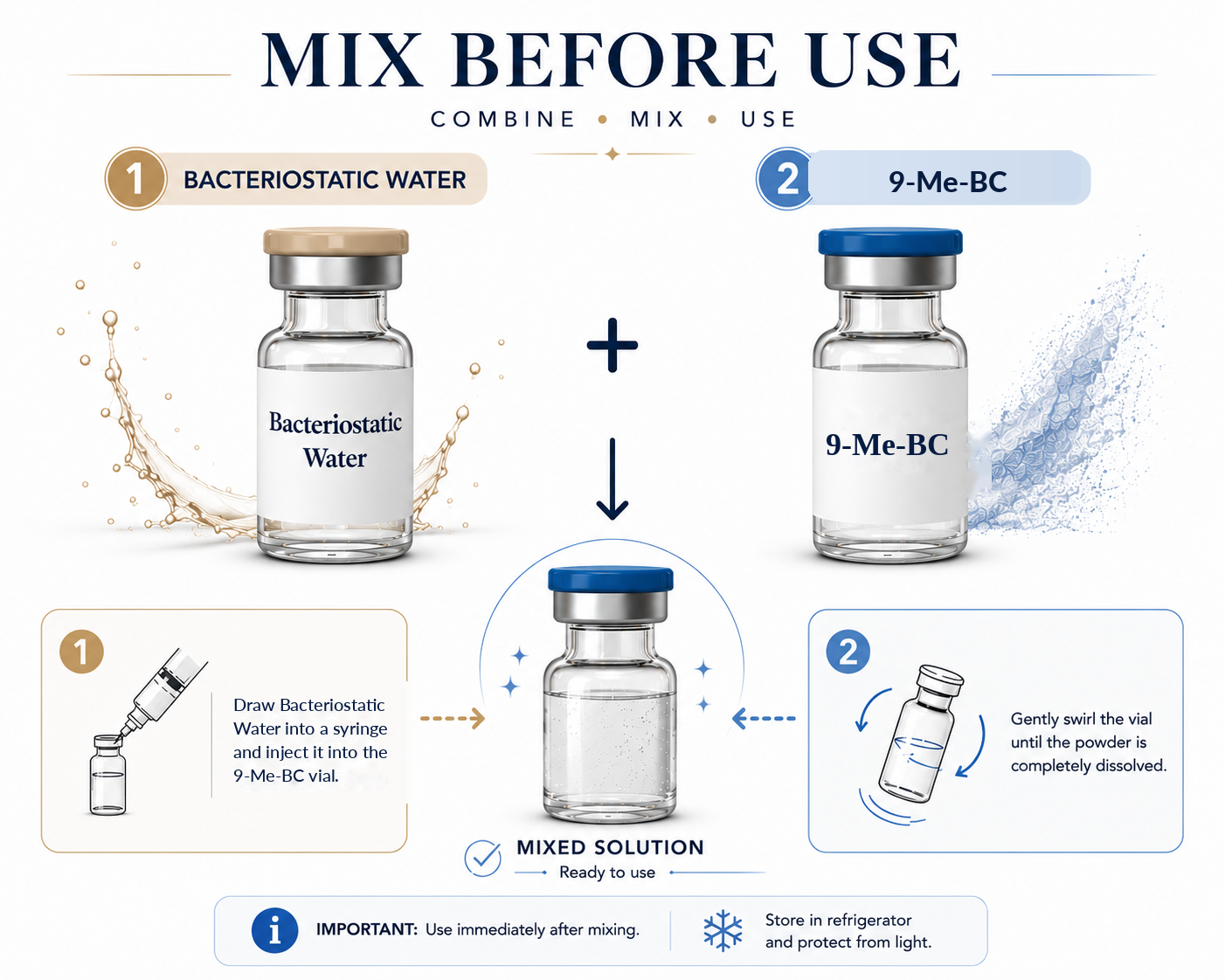
9-Me-BC and BAC Water Mix

9-Me-BC Reconstitution Calculator

Enter the amount you want to measure. The vial buttons will highlight which vial strengths create cleaner syringe-unit measurements.

What amount do you need?

Type the target amount, then choose mg or mcg. Example: 2mg or 500mcg.

Syringe size:
Possible vial strengths:
Best Match Good Match Usable Harder to Measure

Example 9-Me-BC Titration Schedule

.

Usage Protocols (Based on Preclinical & Anecdotal Data)
Parameter Details
Standard Clinical Dose (Preclinical Studies) In rodent studies, doses range from 10 mg to 50 mg per day. One 2010 study used 2 μmol/100 g of body weight over 10 days.
User-Reported Nootropic Dosage The most common dosage reported is 15-30 mg per day. Due to its potency, some users advise starting as low as 2 mg/day.
Onset of Effects Not immediate. The neuroregenerative benefits of 9-Me-BC are believed to build up over time. Many users take it for a period (e.g., a month) and then cycle off.
Administration Routes Anecdotal reports mention sublingual administration (holding liquid under the tongue) for 10-20 minutes to increase bioavailability, but it is often described as having a strong, metallic taste. Some anecdotal reports also mention intranasal and oral use.
Possible vial strengths:

What Is It?

9-Me-BC

9-Methyl-beta-carboline research compound.

Bacteriostatic Water

Sterile water containing a bacteriostatic preservative, commonly used when preparing multi-use research vials.

How To Mix 9-Me-BC

1
Clean

Use alcohol swabs to clean the tops of both vials.

2
Draw BAC Water

Draw the selected amount of bacteriostatic water.

3
Inject Slowly

Add the liquid slowly down the side of the vial.

4
Swirl Gently

Do not shake. Swirl gently until dissolved.

5
Store Properly

Store as directed and protect from heat and light.

Best Practices & Common Mistakes

Best Practices

  • Use sterile technique.
  • Protect from light and heat.
  • Store refrigerated when appropriate.
  • Use clean syringe-unit math before measuring.

Common Mistakes

  • Confusing milligrams with milliliters.
  • Choosing an option with awkward decimal units.
  • Using too little liquid for very small measurements.
  • Shaking the vial aggressively.

9-Me-BC Storage & Handling

Lyophilized Powder: −20°C (−4°F) for long-term storage (up to 24 months). Refrigeration 2–8°C (36–46°F) for short-term use (up to ~3 months). Original sealed vial in the freezer is safest.
Reconstituted Solution: 2–8°C (36–46°F), use within ~7–14 days. Keep sealed, avoid light, and do not repeat freeze-thaw cycles.

Frequently Asked Questions

No — 9-Me-BC (9-methyl-β-carboline) isn't a peptide at all, so there's nothing to reconstitute. It's a small β-carboline molecule (formula C₁₂H₁₀N₂) taken by mouth as a powder, capsule, or sublingual liquid, which means no lyophilized vial, no bacteriostatic water, and no injection. If you came here for the mixing math used with injectable peptides, that handling doesn't apply to this compound.
9-Me-BC is a research-chemical nootropic from the β-carboline family, studied mainly for its effects on dopamine. In rodent and cell studies it acts as a monoamine oxidase (MAO-A) inhibitor while also stimulating the growth and protection of dopaminergic neurons, raising tyrosine hydroxylase and neurotrophic factors, and reducing neuroinflammation — which is why it's been floated for Parkinson's and cognition research. Almost all of this comes from a single German research group, entirely in animals, and the popular idea that it "resets" dopamine after stimulant burnout is an anecdotal community claim, not an established finding.
It's used orally — as a powder, capsule, or sublingual liquid — rather than injected, and it appears to be orally active. Because there are no human trials, there's no validated dose; the low-milligram figures that circulate in nootropic communities are anecdotal and extrapolated rather than established, and given the safety concerns below, that uncertainty matters. Keep the powder sealed, dry, cool, and out of light, and treat any dosing decision here as one being made well ahead of the evidence.
This is the concern that sets 9-Me-BC apart: β-carbolines, including this one, can become phototoxic under UV or sunlight and form DNA-damaging adducts, which raises a real genotoxicity flag. For that reason, research handling guidance is to avoid UV and sun exposure during and after use. In cell studies it also shows dose-dependent toxicity at higher concentrations, and its long-term safety in mammals simply hasn't been established.
Caution here is warranted, not optional. As an MAO-A inhibitor, 9-Me-BC carries the classic interaction risks of that drug class — combining it with tyramine-rich aged foods can spike blood pressure, mixing it with serotonergic drugs risks serotonin syndrome, and stacking it with stimulants like Adderall is specifically dangerous rather than synergistic. On top of that, it belongs to a β-carboline family that includes dopaminergic neurotoxins structurally similar to it, so while 9-Me-BC itself looked neuroprotective in studies, the class-level concern and the absence of human safety data are reasons to treat it seriously.
Practical takeaway: If your real goal is weight or metabolic health, the most useful next step is discussing approved treatment options with a clinician rather than relying on an unapproved compound.
Important: This tool is for informational and research-reference purposes only. Not intended for human or veterinary use.
← All peptides