
Humanin Reconstitution Calculator
Enter the amount you want to measure. The vial buttons will highlight which vial strengths create cleaner syringe-unit measurements.
What amount do you need?
Type the target amount, then choose mg or mcg. Example: 2mg or 500mcg.
Syringe size:
Possible vial strengths:
Best Match
Good Match
Usable
Harder to Measure
Example Humanin Titration Schedule
| Protocol Item | Guidance |
|---|---|
| Dose | 500 mcg – 5 mg per dose |
| Frequency | Varies from every day to once per week |
| Cycle Length | 30-day cycles (can extend longer depending on goal/response) |
| Minimum Cycle Break | 30-day minimum break between cycles |
| Practical Note | Typically, smaller doses are used for more frequent dosing, with larger doses used for less frequent dosing. |
Possible vial strengths:
What Is It?
Humanin
Mitochondrial-derived peptide.
Bacteriostatic Water
Sterile water containing a bacteriostatic preservative, commonly used when preparing multi-use research vials.
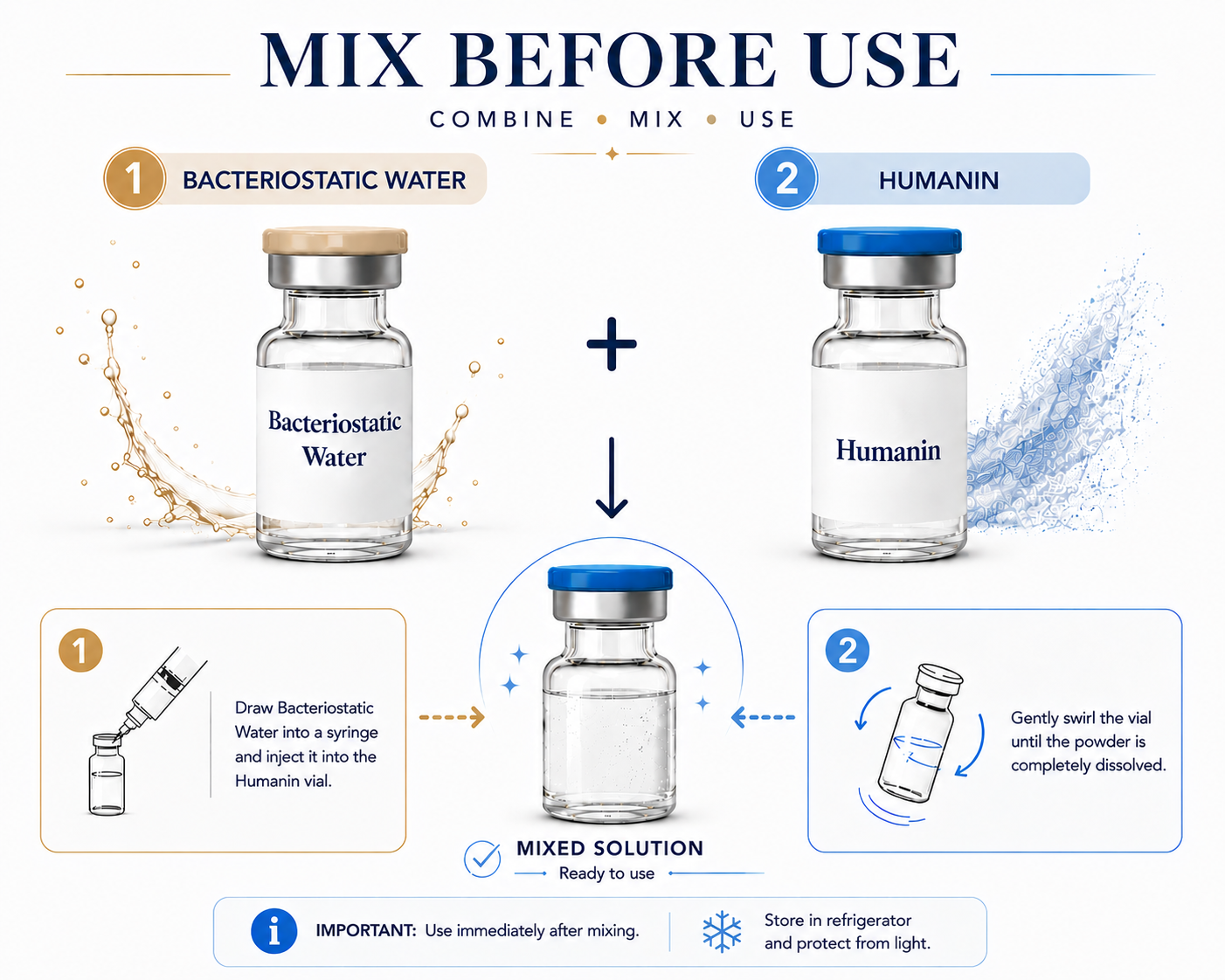
How To Mix Humanin
1
CleanUse alcohol swabs to clean the tops of both vials.
2
Draw BAC WaterDraw the selected amount of bacteriostatic water.
3
Inject SlowlyAdd the liquid slowly down the side of the vial.
4
Swirl GentlyDo not shake. Swirl gently until dissolved.
5
Store ProperlyStore as directed and protect from heat and light.
Best Practices & Common Mistakes
Best Practices
- Use sterile technique.
- Protect from light and heat.
- Store refrigerated when appropriate.
- Use clean syringe-unit math before measuring.
Common Mistakes
- Confusing milligrams with milliliters.
- Choosing an option with awkward decimal units.
- Using too little liquid for very small measurements.
- Shaking the vial aggressively.
Humanin Storage & Handling
Lyophilized Powder: −20°C (−4°F) for long-term storage (up to 24 months). Refrigeration 2–8°C (36–46°F) for short-term use (up to ~3 months). Original sealed vial in the freezer is safest.
Reconstituted Solution: 2–8°C (36–46°F), use within ~7–14 days. Keep sealed, avoid light, and do not repeat freeze-thaw cycles.
Frequently Asked Questions
Humanin is a 24-amino-acid peptide that's unusual in being encoded inside mitochondrial DNA (the MT-RNR2 region) rather than the cell nucleus, and it was the first of the "mitochondrial-derived peptides" ever identified. It was discovered in 2001 in the surviving neurons of an Alzheimer's patient, and its core job is cytoprotection — chiefly by blocking the pro-apoptotic protein BAX to stop cells from dying, alongside binding IGFBP-3 and switching on STAT3 survival signaling. It's studied for neuroprotection, heart protection, insulin sensitivity, and longevity, though the evidence so far is preclinical.
It comes as a lyophilized powder, so add bacteriostatic water down the vial wall, swirl gently, and don't shake. As a worked example, a 10 mg vial with 3 mL of bacteriostatic water gives 3.33 mg/mL, so a 1.5 mg dose would be 0.45 mL — 45 units on a U-100 insulin syringe. Because there are no human dose-ranging studies, treat any figure like this as extrapolated from animal work rather than an established amount.
All three get grouped as "mitochondrial peptides," but they aren't the same kind of thing. Humanin and MOTS-c are both mitochondrial-derived peptides — Humanin is a 24-residue cytoprotective, anti-apoptotic peptide from the 16S rRNA region, while MOTS-c is a shorter 16-residue peptide from the 12S rRNA region that's more about metabolism and AMPK signaling. SS-31 (elamipretide) is a different beast entirely: a synthetic tetrapeptide that isn't mitochondria-encoded at all and works by binding cardiolipin to stabilize the inner mitochondrial membrane.
S14G-Humanin — also written HNG or [Gly14]-Humanin — is an engineered version of Humanin with a single change: serine swapped for glycine at position 14. That one substitution makes it roughly 1000 times more potent than natural Humanin across the neuroprotective, cardioprotective, and metabolic effects that have been studied. In practice that means it isn't dosed like plain Humanin at all, and a lot of the more striking animal data — including cognitive-decline work — actually used HNG rather than the wild-type peptide.
Humanin has no completed human trials and no established safety profile, so it should be treated as an early-stage research compound that isn't FDA-approved. The specific thing worth flagging is its mechanism: because Humanin works by preventing apoptosis (programmed cell death), the same cytoprotection that looks beneficial for neurons could in theory also shield cancer cells, and it has been studied on both sides of that question. That anti-apoptotic double edge, together with the absence of human data, is the reason to be cautious rather than assume it's harmless.
Practical takeaway: If your real goal is weight or metabolic health, the most useful next step is discussing approved treatment options with a clinician rather than relying on an unapproved compound.
Important: This tool is for informational and research-reference purposes only. Not intended for human or veterinary use.