Need a Reliable Peptide Supplier? Click HERE!!!SponsoredVisit ↗
Noopept and BAC Water Mix

Noopept Reconstitution Calculator

Enter the amount you want to measure. The vial buttons will highlight which vial strengths create cleaner syringe-unit measurements.

What amount do you need?

Type the target amount, then choose mg or mcg. Example: 2mg or 500mcg.

Work the dose out from body weight

Syringe size:
Possible vial strengths:
Best Match Good Match Usable Harder to Measure

Example Noopept Titration Schedule

ParameterDetails
Clinical dose20 mg/day (10 mg ×2), max 30
Onset20–60 min (oral)
Half-life~5–10 min rodent; human slower

Label-accurate table. Two corrections: the '3–5 h duration' is community folklore (effects unfold over days via gene expression), and '1000× piracetam' is a weight-based rat comparison — the evidence ledger rates it non-translatable to human potency.

Possible vial strengths:

What Is It?

Noopept

Dipeptide nootropic compound.

Bacteriostatic Water

Sterile water containing a bacteriostatic preservative, commonly used when preparing multi-use research vials.

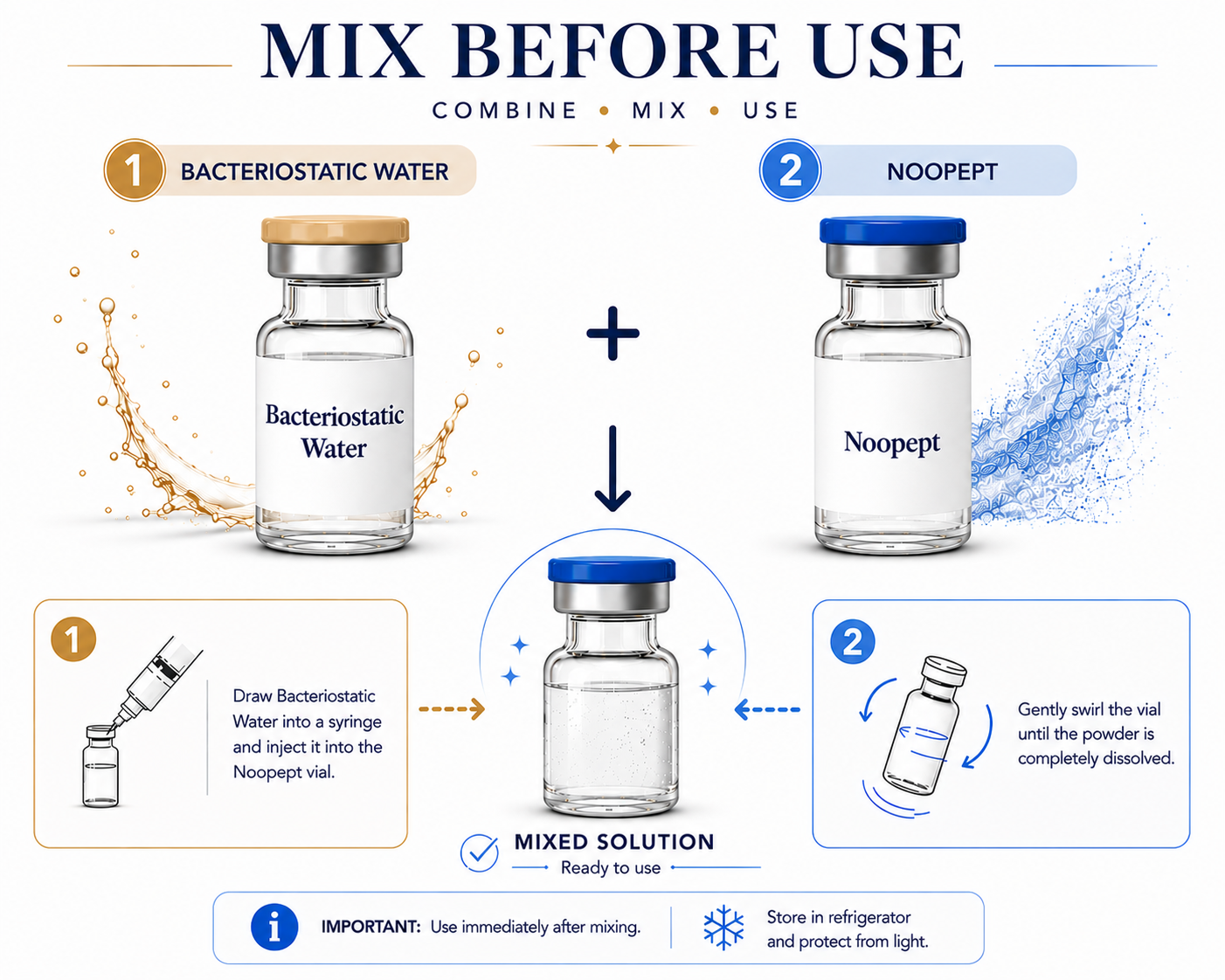
How To Mix Noopept

1
Clean

Use alcohol swabs to clean the tops of both vials.

2
Draw BAC Water

Draw the selected amount of bacteriostatic water.

3
Inject Slowly

Add the liquid slowly down the side of the vial.

4
Swirl Gently

Do not shake. Swirl gently until dissolved.

5
Store Properly

Store as directed and protect from heat and light.

Best Practices & Common Mistakes

Best Practices

  • Use sterile technique.
  • Protect from light and heat.
  • Store refrigerated when appropriate.
  • Use clean syringe-unit math before measuring.

Common Mistakes

  • Confusing milligrams with milliliters.
  • Choosing an option with awkward decimal units.
  • Using too little liquid for very small measurements.
  • Shaking the vial aggressively.

Noopept Storage & Handling

Lyophilized Powder: −20°C (−4°F) for long-term storage (up to 24 months). Refrigeration 2–8°C (36–46°F) for short-term use (up to ~3 months). Original sealed vial in the freezer is safest.
Reconstituted Solution: 2–8°C (36–46°F), use within ~7–14 days. Keep sealed, avoid light, and do not repeat freeze-thaw cycles.

Frequently Asked Questions

No — this is the rare calculator page where there's nothing to reconstitute. Noopept (omberacetam / GVS-111) is an orally active compound sold as powder, capsules, or tablets, so there's no lyophilized vial, no bacteriostatic water, and no injection step involved. If you arrived expecting the mixing math used for injectable peptides, that handling simply doesn't apply here — Noopept is swallowed or taken under the tongue.
Noopept is a synthetic nootropic (N-phenylacetyl-L-prolylglycine ethyl ester, also coded GVS-111) developed in Russia in the 1990s and approved there as a prescription treatment for cognitive disorders. It's peptide-derived — built on a dipeptide — but the added phenylacetyl group and ethyl ester make it technically a small molecule, which is exactly why it can be absorbed orally when true peptides can't. In the body it works as a prodrug, converting into cycloprolylglycine (a naturally occurring brain peptide) and upregulating neurotrophic factors such as BDNF and NGF rather than acting as a stimulant.
Research and clinical use centers on 10–30 mg per day by mouth or sublingually — notably about 1000 times lower than a comparable piracetam dose. It doesn't depend on fasting or blood sugar the way growth-hormone peptides do, and because absorption is modest, some take it with a meal containing fats or place it under the tongue. A choline source is sometimes paired with it, though that's optional and individual rather than a strict requirement, and courses are usually run for a number of weeks rather than indefinitely.
Noopept powder is broadly water-soluble but doesn't dissolve cleanly in plain water, and to be clear, any dissolving is for making an oral or sublingual liquid — never for injection. People who mix it usually do so to measure small doses more accurately or to take it under the tongue, and pairing it with a healthy fat can help absorption. Store the powder sealed, cool, dry, and out of light, and treat any liquid you prepare as short-lived rather than something to keep around.
Noopept has decades of Russian clinical use and preclinical studies pointing to low toxicity, but it is not FDA-approved, and in the US it sits in a shifting gray area — sold as a "research chemical" or supplement and notably pulled from some major marketplaces. Its legal status varies by country, so it's worth checking your local rules before assuming access. It's meant to be taken orally or sublingually; alternative routes and recreational drug combinations aren't supported by evidence and add avoidable risk, and none of this replaces a clinician's guidance.
Practical takeaway: If your goal involves weight management, metabolic health, recovery, physical performance, cognitive function, appearance, or general well-being, discuss it with a licensed healthcare professional. They can help you evaluate approved, evidence-based options rather than relying on an unapproved or investigational compound. This calculator is intended only for transparent research-reference calculations and does not determine an appropriate amount, recommend use, or replace professional medical guidance.

About the author

Maria Hrabina is a pharmacist and scientific reviewer with a strong interest in peptide science, pharmacology, and emerging therapeutic compounds.

Her work focuses on understanding how peptide-based compounds interact with biological signaling pathways and how they are being investigated across areas such as metabolic health, dermatology, recovery, regenerative research, and pharmaceutical development.

Maria follows research on a broad range of peptides, from compounds used in approved medicines to experimental molecules still being evaluated in laboratory, preclinical, and clinical studies.

Her approach combines scientific curiosity with critical evaluation of evidence. She believes promising mechanisms and early research deserve attention, but should not be presented as established clinical benefits until they are supported by adequate human data.

Her areas of focus include scientific literature review, mechanisms of action, pharmacology, pharmacokinetics, safety, pharmaceutical formulation, and the overall quality of evidence behind peptide-based compounds.

She is particularly interested in the process of translating an experimental molecule into a reliable pharmaceutical product — including compound characterization, purity, stability, formulation, dose selection, safety assessment, and controlled clinical trials.

Maria believes peptide science has significant long-term potential, but that its progress depends on rigorous research, high manufacturing standards, transparent safety data, and responsible scientific communication.

Through her writing, she aims to help readers understand both sides of peptide research: what makes these compounds scientifically promising and what questions remain before their potential can be considered clinically established.

Areas of interest: Peptide Science · Therapeutic Peptides · Peptide Pharmacology · Metabolic Peptides · Cosmetic Peptides · Drug Development · Pharmacokinetics · Drug Safety · Pharmaceutical Formulation · Emerging Therapies · Evidence-Based Medicine

Important: This tool is for informational and research-reference purposes only. Not intended for human or veterinary use.
← All peptides