
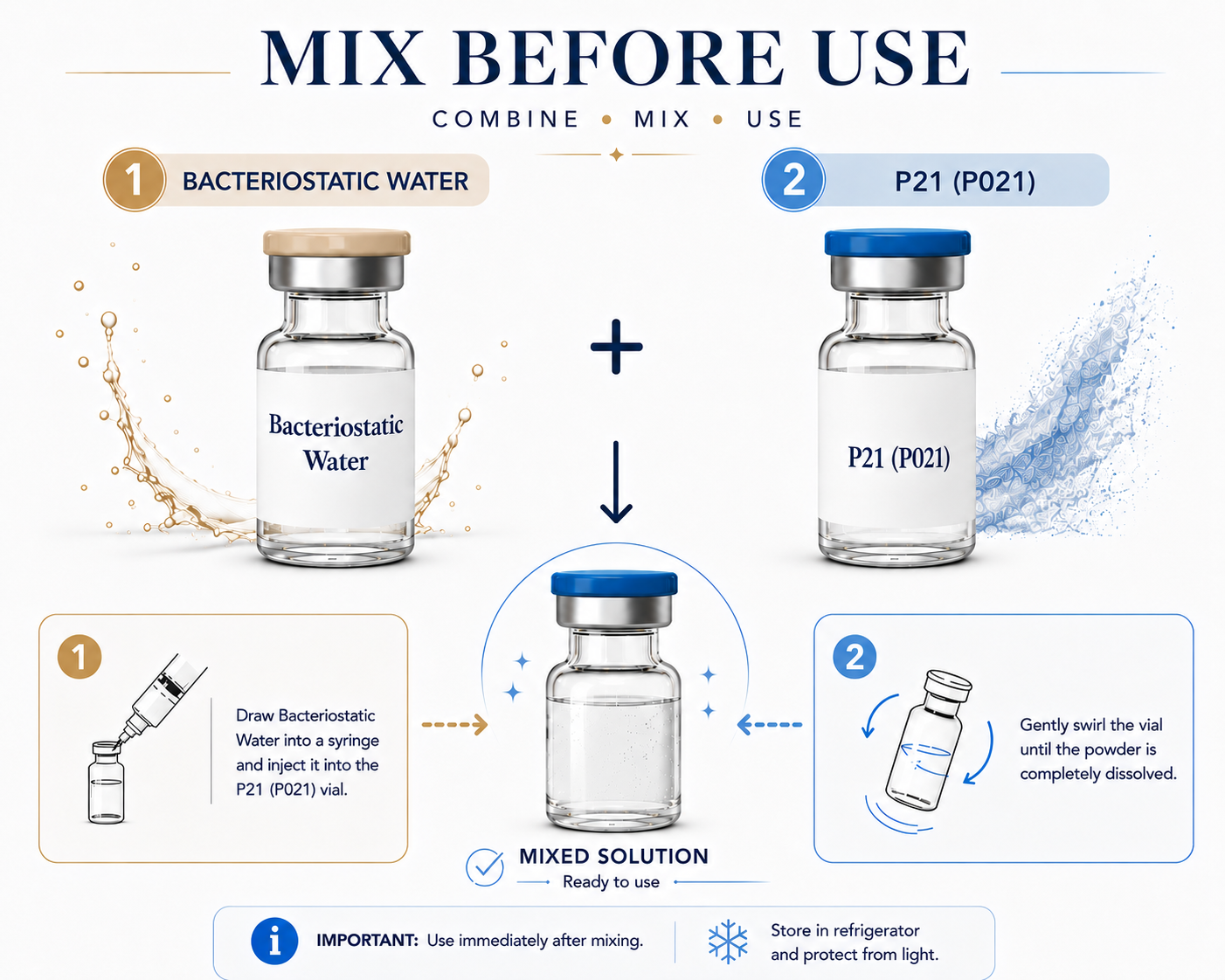
P21 (P021) and BAC Water Mix

P21 (P021) Reconstitution Calculator

Enter the amount you want to measure. The vial buttons will highlight which vial strengths create cleaner syringe-unit measurements.

What amount do you need?

Type the target amount, then choose mg or mcg. Example: 2mg or 500mcg.

Syringe size:
Possible vial strengths:
Best Match Good Match Usable Harder to Measure

Example P21 (P021) Titration Schedule

Protocol ItemGuidance
Dose100–500 mcg per dose
CyclingDaily, for 30-day cycles (or shorter), with a 30-day minimum cycle break between
Possible vial strengths:

What Is It?

P21 (P021)

CNTF-derived peptide in neurogenesis research.

Bacteriostatic Water

Sterile water containing a bacteriostatic preservative, commonly used when preparing multi-use research vials.

How To Mix P21 (P021)

1
Clean

Use alcohol swabs to clean the tops of both vials.

2
Draw BAC Water

Draw the selected amount of bacteriostatic water.

3
Inject Slowly

Add the liquid slowly down the side of the vial.

4
Swirl Gently

Do not shake. Swirl gently until dissolved.

5
Store Properly

Store as directed and protect from heat and light.

Best Practices & Common Mistakes

Best Practices

  • Use sterile technique.
  • Protect from light and heat.
  • Store refrigerated when appropriate.
  • Use clean syringe-unit math before measuring.

Common Mistakes

  • Confusing milligrams with milliliters.
  • Choosing an option with awkward decimal units.
  • Using too little liquid for very small measurements.
  • Shaking the vial aggressively.

P21 (P021) Storage & Handling

Lyophilized Powder: −20°C (−4°F) for long-term storage (up to 24 months). Refrigeration 2–8°C (36–46°F) for short-term use (up to ~3 months). Original sealed vial in the freezer is safest.
Reconstituted Solution: 2–8°C (36–46°F), use within ~7–14 days. Keep sealed, avoid light, and do not repeat freeze-thaw cycles.

Frequently Asked Questions

This page is about the research peptide P21 (also written P021 or Peptide 21), a synthetic tetrapeptide — Ac-DGGL(A)G-NH₂ — engineered as a mimetic of ciliary neurotrophic factor (CNTF). It's easy to confuse with the unrelated p21 protein (also called p21^CIP1/WAF1 or CDKN1A), the cell-cycle inhibitor that p53 switches on to halt cell division — that's a natural tumor-suppressor protein, not something sold as a research compound. If your interest is p53 signaling, CDK inhibition, or tumor biology, you want the protein; this calculator is for the neurogenic peptide.
P021 was developed in Khalid Iqbal's lab by paring the neurotrophic activity of Cerebrolysin down to a single small molecule, with an adamantane group and a C-terminal amide added so it survives in the body and reaches the brain. In rodent studies it stimulates new neuron growth in the hippocampus and raises BDNF, apparently by blocking LIF signaling, which in turn dampens GSK-3β and reduces the abnormal tau phosphorylation tied to Alzheimer-type pathology. Importantly, all of this evidence is preclinical — the picture comes from animal models, with no human trials.
It's sold as a lyophilized powder, so add bacteriostatic water down the vial wall, swirl gently, and don't shake. As an illustrative example, a 5 mg vial with 3 mL of bacteriostatic water gives 1.67 mg/mL, so a 500 mcg dose would be 0.3 mL — 30 units on a U-100 insulin syringe. Treat any dose figure as extrapolated from animal work rather than an established human amount, since there's no validated clinical dosing.
Unusually for a peptide, P021 was deliberately engineered to be orally bioavailable and to cross the blood-brain barrier — that's the whole point of the adamantane modification, and the rodent studies mostly gave it by mouth. Because of that, it shows up not only as a reconstituted injectable-style solution but also as capsules and nasal sprays, and the pre-made sprays aren't something you reconstitute. This calculator covers the lyophilized powder; which route you'd use is a separate research decision from how you mix it.
In the Iqbal-lab literature P021 was tested in models of Alzheimer's disease, Down syndrome, traumatic brain injury, and neurodevelopmental disorders such as CDKL5 deficiency — which is where the "autism" interest comes from — all in rodents, none in people. Because its core action is driving cell proliferation and neurogenesis, the main theoretical safety concern is anyone with active or prior cancer, and caution is also raised for seizure disorders, autoimmune conditions, pregnancy, and still-developing brains. It isn't FDA-approved and has no human safety data, so it should be treated as an early-stage research compound.
Practical takeaway: If your real goal is weight or metabolic health, the most useful next step is discussing approved treatment options with a clinician rather than relying on an unapproved compound.
Important: This tool is for informational and research-reference purposes only. Not intended for human or veterinary use.
← All peptides