
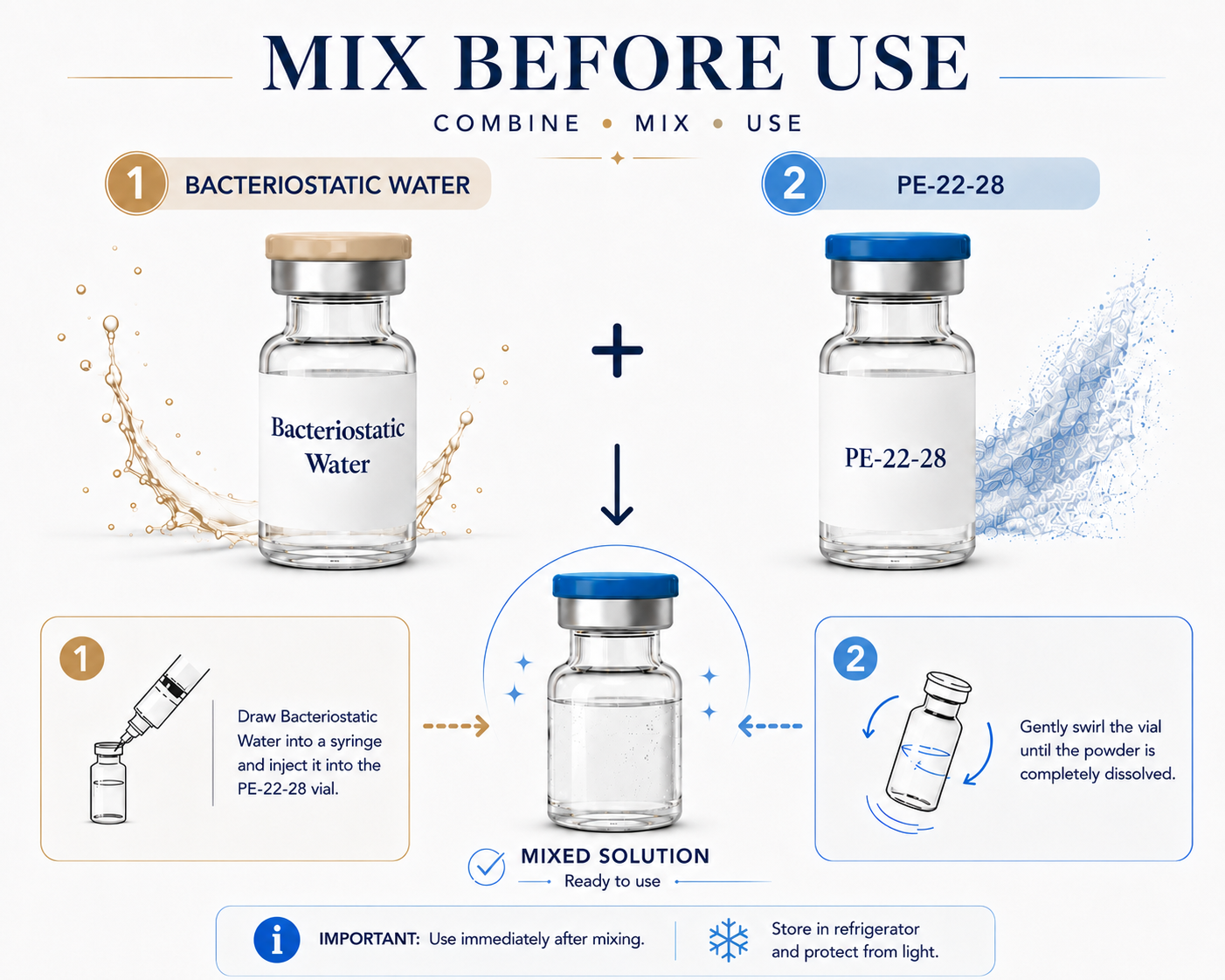
PE-22-28 and BAC Water Mix

PE-22-28 Reconstitution Calculator

Enter the amount you want to measure. The vial buttons will highlight which vial strengths create cleaner syringe-unit measurements.

What amount do you need?

Type the target amount, then choose mg or mcg. Example: 2mg or 500mcg.

Syringe size:
Possible vial strengths:
Best Match Good Match Usable Harder to Measure

Example PE-22-28 Titration Schedule

Protocol ItemGuidance
Dosing200–600 mcg daily
CyclingDaily for 30-day cycles (or shorter), with a 30-day minimum cycle break between
Daily DoseVolume @ 4 mg/mL (8 mg / 2.0 mL)
200 mcg (0.2 mg)0.05 mL (5 units)
400 mcg (0.4 mg)0.10 mL (10 units)
600 mcg (0.6 mg)0.15 mL (15 units)
Possible vial strengths:

What Is It?

PE-22-28

Spadin analogue studied for mood models.

Bacteriostatic Water

Sterile water containing a bacteriostatic preservative, commonly used when preparing multi-use research vials.

How To Mix PE-22-28

1
Clean

Use alcohol swabs to clean the tops of both vials.

2
Draw BAC Water

Draw the selected amount of bacteriostatic water.

3
Inject Slowly

Add the liquid slowly down the side of the vial.

4
Swirl Gently

Do not shake. Swirl gently until dissolved.

5
Store Properly

Store as directed and protect from heat and light.

Best Practices & Common Mistakes

Best Practices

  • Use sterile technique.
  • Protect from light and heat.
  • Store refrigerated when appropriate.
  • Use clean syringe-unit math before measuring.

Common Mistakes

  • Confusing milligrams with milliliters.
  • Choosing an option with awkward decimal units.
  • Using too little liquid for very small measurements.
  • Shaking the vial aggressively.

PE-22-28 Storage & Handling

Lyophilized Powder: −20°C (−4°F) for long-term storage (up to 24 months). Refrigeration 2–8°C (36–46°F) for short-term use (up to ~3 months). Original sealed vial in the freezer is safest.
Reconstituted Solution: 2–8°C (36–46°F), use within ~7–14 days. Keep sealed, avoid light, and do not repeat freeze-thaw cycles.

Frequently Asked Questions

PE-22-28 is a synthetic seven-amino-acid peptide taken from a piece of spadin — a natural fragment of the sortilin protein — and its job is to block the TREK-1 potassium channel in the brain. That mechanism is the whole point: mice lacking TREK-1 are resistant to depression, so inhibiting the channel produces fast antidepressant-like effects in rodent tests, and PE-22-28 does it far more potently than spadin itself while also boosting hippocampal neurogenesis. It's a genuinely novel approach compared with SSRIs, ketamine, or psychedelics — but so far the evidence is entirely preclinical.
It comes as a lyophilized powder, so add bacteriostatic water down the vial wall, swirl gently, and don't shake. As an illustrative example, an 8 mg vial with 6 mL of bacteriostatic water gives 1.33 mg/mL, so a 400 mcg dose would be 0.3 mL — 30 units on a U-100 insulin syringe. Since there are no human dosing studies, treat any figure like this as extrapolated from animal work rather than an established amount.
In the research, PE-22-28 and its parent spadin were given by injection, and that's the form this calculator covers — the reconstituted lyophilized powder. It's also sold as a pre-made nasal spray, which is dosed per spray and isn't something you reconstitute yourself; nasal delivery is often chosen for peptides to ease brain access and skip injections. Which route makes sense is a separate question from the mixing math, and neither has validated human dosing behind it.
All three get lumped together as "mood and brain" peptides, but they act through completely different targets. PE-22-28 blocks the TREK-1 potassium channel as an antidepressant strategy, Selank is a tuftsin-derived anxiolytic that modulates GABA (calming rather than mood-lifting), and Dihexa works on the HGF/c-Met pathway aimed at synapse formation and cognition. They aren't interchangeable, so if you're comparing them it's worth reading each on its own terms rather than treating them as versions of one thing.
Because PE-22-28 has only been studied in animals, its side-effect profile in humans is essentially unknown, and no completed clinical trials establish that it's safe or effective. It's important to be clear that this is an early-stage research compound, not a treatment for depression — depression is a serious medical condition that warrants care from a qualified professional, and PE-22-28 is not a substitute for that. It isn't FDA-approved, and blocking a channel involved in mood, pain, and other functions simply hasn't been characterized for safety in people.
Practical takeaway: If your real goal is weight or metabolic health, the most useful next step is discussing approved treatment options with a clinician rather than relying on an unapproved compound.
Important: This tool is for informational and research-reference purposes only. Not intended for human or veterinary use.
← All peptides